Cloud Capping Paint: How It Differs From Color Drenching
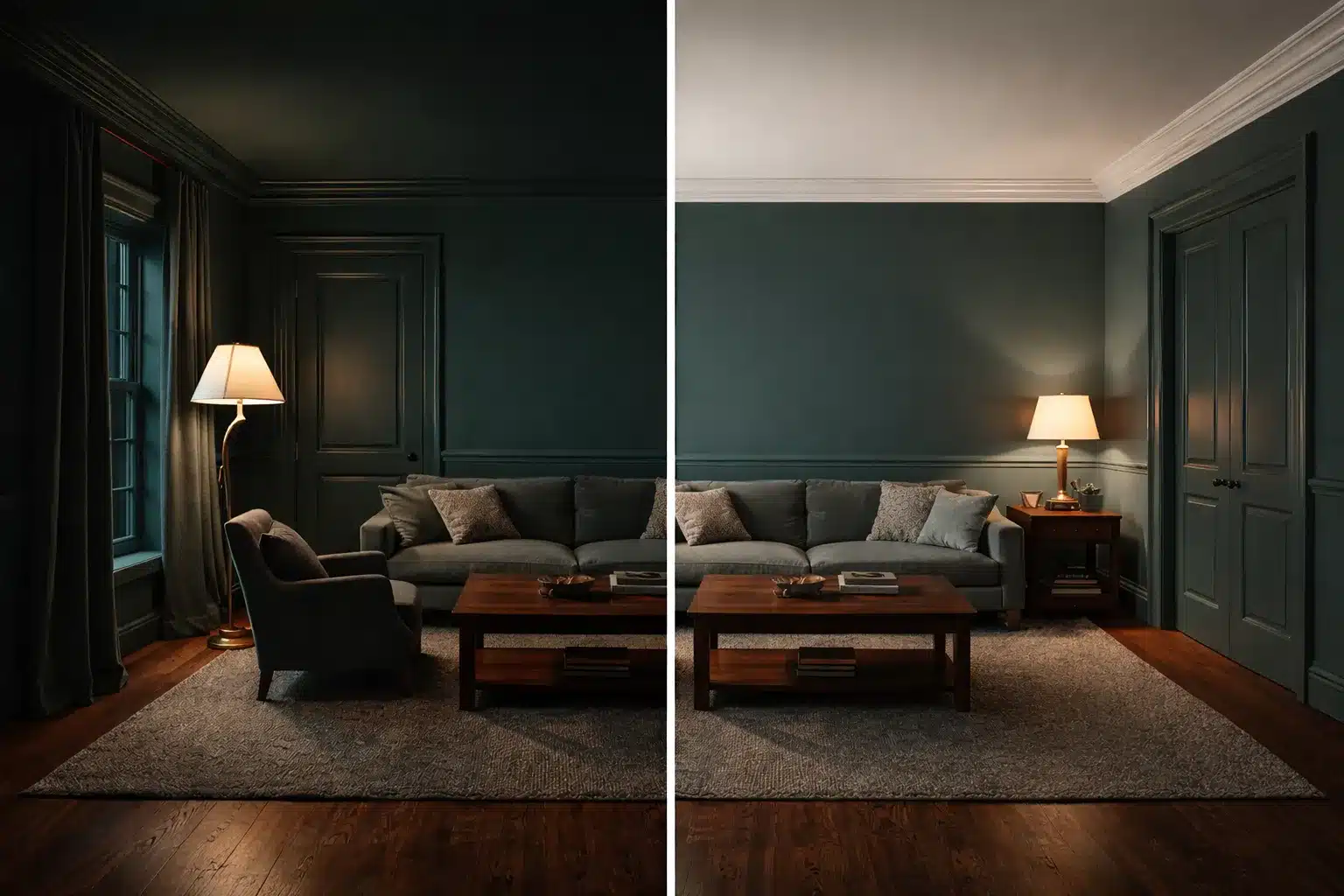
Quick answer: Cloud capping keeps the walls, trim, doors, and other woodwork in one connected color, then uses a softer white or pale neutral on the ceiling. The key is undertone. The ceiling color should relate to the wall color rather than reading as a sharp, unrelated white.
Think of it as the lighter cousin of color drenching. You still get a strong envelope of color around the room, but the ceiling becomes a quieter, lighter plane.
What Is Cloud Capping?
Cloud capping is a paint technique that carries one color across the walls and woodwork, then finishes the ceiling in a light coordinating tone. Recent design coverage credits Lick’s Tash Bradley with describing the approach as a way to keep the room cohesive while giving the ceiling a softer presence.
House Beautiful, Livingetc, and Homebuilding all covered the technique in August 2026.
The defining move is not “paint the ceiling white.” It is “choose a lighter ceiling color that belongs with the wall color.”
Cloud Capping vs. Color Drenching vs. Color Capping
| Technique | Walls & Woodwork | Ceiling | Overall Effect |
|---|---|---|---|
| Cloud capping | One connected color | Soft white or pale neutral with related undertones | Cohesive color with a lighter ceiling |
| Color drenching | One color or closely related tone | Usually the same color family, often the same hue | More enveloping and cocooning |
| Color capping | One or more coordinated tones | A contrasting or deeper color treatment | More visible separation and emphasis at the ceiling |
Color capping and cloud capping sound similar, but the ceiling treatment moves in opposite directions. Color capping calls attention to the ceiling with stronger color. Cloud capping softens it with a pale companion.
Why the Ceiling White Matters
A brilliant white can create a hard line between a saturated wall and the ceiling. Cloud capping avoids that snap by using a white or pale neutral with a compatible undertone.
Benjamin Moore recommends choosing a ceiling white that shares a similar undertone with the walls when you want seamless color flow. The brand also recommends sampling ceiling colors because room direction and lighting affect how they appear. See Benjamin Moore’s ceiling-color guidance.
Sherwin-Williams also emphasizes undertones when choosing whites. Warm whites can carry yellow, red, or orange undertones, while cool whites can lean green, blue, or violet. See Sherwin-Williams white-paint guidance.
How to Pair a Ceiling White With Your Wall Color
Warm Green or Olive Walls
Start with a creamy or warm off-white rather than a blue-white. The ceiling should feel related to the yellow or earthy side of the green.
Dusty Blue or Blue-Gray Walls
Look at whites with soft gray, blue, or violet undertones. A warm ivory can turn muddy next to a cool blue-gray.
Clay, Terracotta, or Rust Walls
Soft cream, parchment, or warm white tends to keep the ceiling connected to the wall color without repeating the saturation overhead.
Mushroom, Taupe, or Cocoa Walls
Compare warm off-whites with beige, gray, or muted red undertones. The goal is not a perfect color match. It is a ceiling that does not look accidentally icy beside the walls.
Plum or Aubergine Walls
Try muted whites with gentle violet, taupe, or warm gray undertones before jumping to a bright gallery white.
Sample the Ceiling Color in the Actual Room
Do not choose the cloud-capping white from a screen alone. Whites change dramatically under natural and artificial light.
Place a large sample near the top of the wall and, if practical, test the ceiling candidate on the ceiling itself. Check it in morning light, afternoon light, and after dark with the lamps you actually use.
The relationship matters more than the paint chip names. Two colors can look related in a store and separate sharply once they are surrounded by your flooring, furniture, curtains, and bulbs.
If you want a researched starting list for samples, brushes, rollers, trim paint, and room details, see my Color Drenching Benable list. The list contains affiliate links, and I may earn a commission from qualifying purchases.
Does Cloud Capping Make a Small Room Feel Bigger?
It can make a room feel lighter or more open, especially when the ceiling is lighter than the walls, but that is not a guarantee for every room.
House Beautiful and Livingetc both discuss the technique as useful in smaller rooms or rooms with lower ceilings because the light ceiling can reduce the visual weight overhead. Sherwin-Williams gives similar general guidance for light ceiling colors, noting that a lighter ceiling can make a ceiling appear higher.
Room proportions, window size, wall color, ceiling height, furniture, and lighting still matter. Treat “bigger” as a possible visual effect, not a promised result.
Where Cloud Capping Works Especially Well
Bedrooms
Deep or mid-tone walls can create a cocooning perimeter while a soft ceiling keeps the room from feeling completely enclosed.
Living Rooms
If you like drenched trim and doors but want more brightness overhead, cloud capping gives you both.
Bathrooms
A lighter ceiling can work well with colored walls, paneling, or painted cabinetry. Use paint products and preparation suited to the moisture level and surface.
Low-Ceiling Rooms
The lighter cap can reduce the visual weight at the top of the room. Sampling matters because a pale ceiling that is too stark can create the opposite problem: a hard stripe around the perimeter.
Dark Rooms
Cloud capping lets you use a richer wall color without committing the ceiling to the same depth. For more paint-selection help, see How to Choose Paint Colors to Brighten a Dark Room.
What Sheen Should You Use?
The right sheen depends on the paint line, surface, room, and cleaning needs.
Benjamin Moore recommends flat paint for ceilings because it minimizes reflected light and is forgiving of surface imperfections. Walls and woodwork may call for different finishes. For example, some homeowners use a lower sheen on walls and a more durable finish on doors or trim while keeping the color consistent.
Check the technical guidance for the exact product rather than assuming one sheen rule works for every room.
For a broader finish comparison, see Paint Types & Finishes.
Cloud Capping Paint Order
Benjamin Moore’s ceiling-paint guidance recommends painting the ceiling before the walls. That sequence also makes sense for cloud capping because ceiling drips and roller spatter are easier to correct before the darker wall color is finished.
- Repair and clean the ceiling, walls, trim, and doors as needed.
- Sample both the wall color and ceiling color in the room.
- Paint the ceiling first.
- Paint the walls.
- Finish the trim, doors, built-ins, and other woodwork in the planned color and sheen.
- Check the wall-to-ceiling line in both daylight and evening light.
Always follow the paint manufacturer’s preparation, primer, application, recoat, and ventilation instructions.
Common Cloud Capping Mistakes
Using a Stark White by Habit
The ceiling needs to relate to the wall color. A brilliant white can make the room look chopped in half.
Choosing the Ceiling Color Before the Wall Color
Pick the main room color first. Then choose the ceiling shade in response to its undertone.
Skipping Large Samples
A one-inch chip cannot show how an off-white will behave across an entire ceiling.
Ignoring Artificial Light
Warm bulbs can change a gray-white. Cool bulbs can flatten a creamy white. Check both natural and artificial light.
Adding Too Many Accent Colors
Cloud capping already creates a strong paint relationship. Let furniture, wood, metal, and textiles supply contrast without turning the room into a color chart.
Assuming Every Ceiling Should Be Light
If the room is large, tall, or meant to feel intimate, full color drenching or a deeper ceiling may be the stronger choice.
Cloud Capping vs. Full Color Drenching: Which Should You Choose?
Choose cloud capping when you want saturated walls and woodwork but prefer a lighter ceiling.
Choose full color drenching when you want the ceiling to participate in the same enveloping color story.
Choose color capping when you want the ceiling itself to become a stronger design feature with a deeper or more distinct tone.
There is no universal winner. The room decides.
Plan Paint Quantity Before You Buy
Cloud capping uses at least two paint colors, and often more than one finish. Keep the quantities separate so the ceiling paint does not get lumped into the wall estimate.
- Use the Paint Calculator
- Check Paint Coverage Per Gallon
- Prep Walls for Painting
- Shop the Color Drenching paint-and-decor edit
Cloud Capping FAQs
Is cloud capping the same as painting the ceiling white?
No. The idea is to select a soft white or pale neutral that relates to the undertone of the wall color, rather than defaulting to a bright white.
Does the trim stay the same color as the walls?
That is the usual cloud-capping look described in current design coverage: walls, trim, doors, and woodwork stay connected, while the ceiling changes to the lighter tone.
Can I cloud-cap with neutral walls?
Yes. Mushroom, taupe, beige, soft gray, and other neutrals can all work. The contrast may be subtler than it is with dark green or plum walls.
Can the ceiling be a pale version of the wall color instead of white?
Yes. A pale tonal companion can work if the result stays intentional and connected. Sample it first.
Is cloud capping only for small rooms?
No. Smaller or lower rooms are getting attention because the lighter ceiling can reduce visual weight overhead, but the technique can work in larger rooms too.
Should I use the same paint product on walls, trim, and ceiling?
Not automatically. Different surfaces and use conditions may need different formulations or sheens even when the colors are related. Follow the manufacturer’s product guidance.