Paint Types & Finishes: What Actually Matters When You’re Standing in the Aisle
You’re at the store. You’re staring at rows of paint types and finishes.
One can says “satin.”
Another says “latex.”
There’s a “chalk” paint. It sounds like it belongs in a preschool.
Another paint promises to block every stain known to mankind.
And you’re thinking… what do these even mean?
That was me. I wanted a simple paint job. Instead, I got hit with a dictionary of terms and zero straight answers.
So I dug in. I figured out what works where. I learned what’s worth the extra money. I discovered why paint finishes matter just as much as the color.
If your finish is settled but the color is not, the 90s paint colors guide shows how beige, hunter green, burgundy, sage, plum and teal can work in a current room.
Before you start a room-painting project, use our free Paint Calculator to estimate quantity from the surfaces, coats, and coverage rate you enter. Check the chosen product label before buying. For prep, coverage, cost, tools, and how-to guides, visit Painting Resources.
Key Takeaways Table
| Topic | Quick Facts |
|---|---|
| Paint Types | Latex, acrylic, oil-based, chalk, milk |
| Best for Walls | Latex or acrylic with eggshell or satin finish |
| Best for Trim | Satin or semi-gloss, often acrylic or oil-based |
| Low VOC Options | Look for water-based and labeled “Low-VOC” or “Zero-VOC” |
| Finish Matters | Matte hides flaws, gloss shows them off |
| Durability Ranking | High-gloss > semi-gloss > satin > eggshell > matte |
| Chalk vs Milk | Chalk = modern matte; Milk = rustic antique look |

What Are the Main Paint Types?
Let’s talk base. This part determines how the paint behaves. It affects how it dries. It influences how it smells. It also dictates how easy it is to clean.
🪣 Latex Paint (Water-Based)
Most people use this without realizing it. It’s easy to roll on, dries fast, and doesn’t stink up the place. Plus, you can clean your brushes in the sink.
- Great for walls and ceilings
- Lower VOCs
- Not ideal for high-humidity rooms unless it has additives
🧴 Acrylic Paint
Acrylic is like latex’s tougher sibling. Same water base, but it holds up better outdoors and handles UV rays like a champ.
- Works for both interiors and exteriors
- Stronger color retention
- Usually costs more than basic latex
🛢️ Oil-Based Paint
The heavy hitter. If you’re painting trim, cabinets, or anything you want to hold up for decades, this is your guy.
- Takes longer to dry
- Cleanup requires mineral spirits
- Holds up better under abuse
Important: Some states have restricted oil-based paint sales due to VOC levels, so double-check availability.
Specialty Paint Types
This is where things get weird, but in a good way.

🧵 Chalk Paint
Great for flipping furniture without sanding it down first. Thick, velvety, and leaves a classic matte finish.
- Minimal prep required
- Sticks to just about anything
- Works well for farmhouse or vintage styles. See the rustic farmhouse paint color guide, then shop the rustic farmhouse paint and decor edit.

🥛 Milk Paint
This is the OG. Made with milk protein and lime, it’s eco-friendly and has a soft, historic look.
- Comes in powder form—you mix it yourself
- Best for antique vibes
- Absorbs into wood grain for a textured effect
Paint Finishes: Why They Matter
You can use the best paint in the world. However, the wrong finish will make your wall look awful. It can also make every fingerprint show.
Here’s the breakdown:

🧱 Flat / Matte Finish
- Zero shine
- Hides every dent and ding
- Terrible at resisting dirt or moisture
Where it works: Ceilings, adult bedrooms, formal living rooms

🥚 Eggshell Finish
- Slight sheen, like an actual eggshell
- Easier to wipe down than flat
- Still hides mild imperfections
Where it works: Dining rooms, living rooms, guest rooms

🌫 Satin Finish
- Soft sheen that doesn’t glare
- Washable and moisture-resistant
- Versatile and forgiving
Where it works: Hallways, family rooms, kid bedrooms

✨ Semi-Gloss Finish
- Reflects more light
- Super easy to clean
- Highlights flaws, so prep matters
Where it works: Kitchens, bathrooms, baseboards

💎 High-Gloss Finish
- Shiny like a mirror
- Shows every flaw
- Extremely durable
Where it works: Doors, cabinets, detailed trim

What’s Actually in Paint?
Understanding what’s in a can helps make sense of the price tag. Cheap paint isn’t always a bargain.
Four main parts:
- Pigments: That’s your color.
- Binders: These make the paint stick.
- Solvents: Water or oil that keeps it liquid until applied.
- Additives: Mold protection, flow agents, etc.
Higher-end paint usually means:
- More solids (50–60% instead of 30–40%)
- Better hiding power
- Longer lifespan
- Fewer coats needed
VOCs: Why They Matter
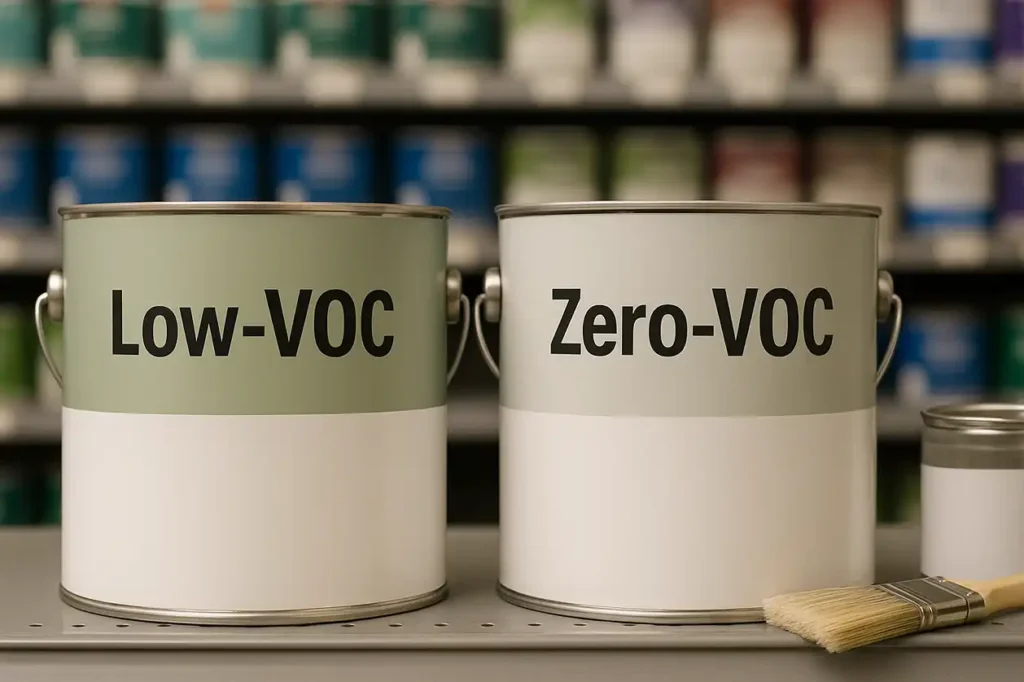
VOCs (Volatile Organic Compounds) are what make some paints smell strong. They can also cause headaches or worse.
Here’s the cheat sheet:
- Traditional Paints: 250–380 g/L
- Low-VOC: Under 50 g/L
- Zero-VOC: Under 5 g/L
If indoor air emissions are a priority, compare the product’s VOC information and ventilation instructions rather than relying on a front-label claim alone. If paint is one part of a larger remodel, see these eco-friendly home renovations for practical ways to reduce energy, water, and material waste across the project.

Primer Talk: What You Actually Need
Don’t skip primer. It’s not just a sales trick—it makes your topcoat look better and stick longer.
🧽 Latex Primer
- Fast drying
- Cleans up with water
- Good for drywall and old paint
🧼 Oil-Based Primer
- Blocks stains like nothing else
- Great for bare wood or damaged surfaces
- Needs solvent cleanup
🧪 Shellac or Specialty Primers
- Best for smoke, water stains, or shiny surfaces
- Dries fast and seals like concrete

Best Application Methods (And When to Use Them)
Don’t let your paint job look like a preschool project. The right tool matters.
Brush & Roller
- Good control
- Less mess
- Ideal for most interior jobs
Sprayer
- Super smooth finish
- Great for large spaces or fine cabinetry
- Takes practice and proper masking
Special Techniques
- Sponging, rag-rolling, or textured rollers
- Mostly used for statement walls or artsy projects

Matching Paint Type and Finish to the Job
Let’s get real. Here’s what works:
| Surface | Paint Type | Finish |
|---|---|---|
| Bedroom Walls | Latex or acrylic | Flat or eggshell |
| Kitchen Walls | Acrylic | Satin or semi-gloss |
| Trim & Baseboards | Acrylic or oil | Satin or semi-gloss |
| Bathroom Ceilings | Acrylic | Satin |
| Furniture | Chalk or acrylic | Satin or high-gloss |
| Exterior Siding | 100% Acrylic | Satin or flat |
| Outdoor Trim | Oil-based or Acrylic | Semi-gloss |
Real-Life Tips That Saved Me Money (And Headaches)
- Always buy samples first. What looks great under store lights might look terrible under yours.
- Prep like it’s your job. A great finish is 90% prep and 10% paint.
- Use a tinted primer if you’re going from dark to light or vice versa.
- Don’t skimp on brushes. Cheap ones shed bristles and ruin the finish.
- Roll in a W-pattern. It helps avoid lap marks and uneven coverage.

FAQs About Paint Types and Paint Finishes
Q: What’s the difference between latex and acrylic paint?
Acrylic is technically a type of latex paint with more acrylic resins. It’s more durable and weather-resistant.
Q: Is flat paint better than eggshell?
Flat hides more flaws, but eggshell is easier to clean. If you’ve got kids, go with eggshell.
Q: Can I use the same paint for walls and trim?
Technically, yes—but trim usually needs a higher sheen for durability and contrast.
Q: What finish is best for bathrooms?
Satin or semi-gloss. You want something moisture-resistant and easy to wipe down.
Q: Do I really need to use primer?
Yes. Especially if the surface is new, stained, glossy, or you’re making a big color change.

Final Word on Paint Types
You don’t need to memorize the whole aisle to pick the right paint. Just match the paint type and finish to the room and how it’ll be used. Latex for most walls. Acrylic if you want durability. Oil-based when you need armor. And always think about sheen—flat hides, gloss reveals.
And just like that, picking the right paint types isn’t overwhelming anymore.