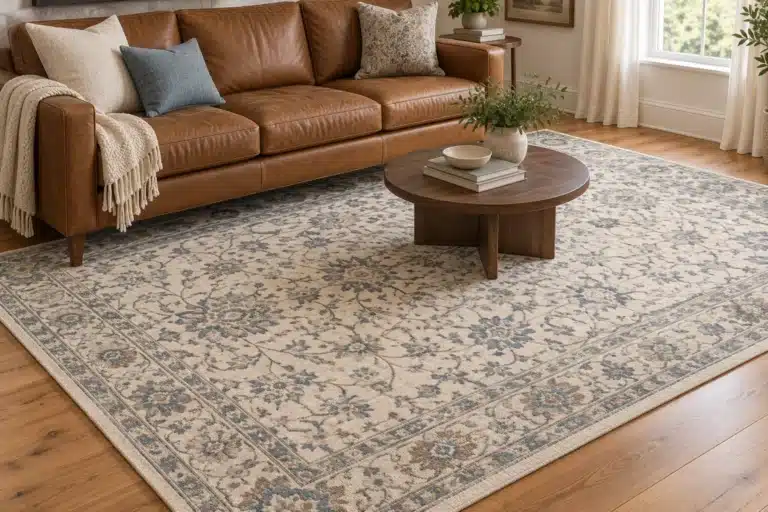

What Color Throw Pillows Go With a Brown Couch?
Throw pillows can connect a brown couch to the rest of the room without buying another large piece of furniture. Building on our brown-sofa living room color guide, start with the rug and curtains you already own. A small repeat of their colors can make the couch feel like part of the room, rather than the brown object you keep decorating around.
What color throw pillows go with a brown couch? Ivory, oatmeal, muted blue, olive and soft clay are useful starting points. For a dark chocolate couch, try lighter pillows that remain visible against the upholstery. For caramel leather, compare cream with blue or olive accents. Choose the accent from an existing rug, curtain or artwork, then test the fabrics together in your room.
The goal is a couch you want to sit on. If every seat requires moving a stack of pillows to the floor, the arrangement needs editing.
Which Pillow Colors Work With Your Brown Couch?
These combinations are styling suggestions, not fixed rules. The same cream cover can look warm beside one sofa and rather stark beside another. Compare the actual materials in daylight and with the lamps you use at night.
| Your Couch and Room | Pillow Combination to Try | What Ties It Together? |
|---|---|---|
| Caramel leather with a blue-and-cream rug | Ivory texture, muted blue solid and a quiet blue stripe | The blue repeats a rug color while ivory separates the pillows from the leather. |
| Chocolate upholstery with cream curtains | Oatmeal, soft olive and an ivory-ground print | A pale background keeps the print visible against the dark couch. |
| Reddish-brown leather with warm wood | Flax, dusty blue and a restrained cream stripe | Blue gives a cooler accent without adding more orange or red. |
| Gray-brown fabric with cooler room colors | Soft ivory, blue-gray and a taupe-and-cream pattern | The taupe connects to the couch without repeating its exact shade. |
| Brown couch with olive curtains | Ivory, a small olive repeat and one quiet neutral pattern | The curtain color appears again in a smaller amount. |
| Brown couch with a colorful patterned rug | One pale neutral and one or two colors already in the rug | The rug supplies the palette; the pillows do not introduce a second competing one. |
Should You Choose the Rug or the Pillows First?
If you are keeping the rug, let it lead. Choose a color that is visible in its pattern and repeat it in a pillow. You do not need a perfect match. Compare whether both fabrics lean muted or vivid, warm or cool, and light or dark.
If the room has no rug yet, settle that larger purchase before buying a full set of pillow covers. Our rug colors for a brown couch and wood floors guide helps you judge the sofa and flooring together. Small accessories are easier to change once that larger surface is decided.
A plain rug leaves more room for a patterned pillow. A busy rug may call for mostly solid pillows with texture. This is about how much pattern you want to see, not a ban on mixing prints.
How Do You Coordinate Pillows With Curtains?
Repeat one curtain color in a small amount, then let the other pillows relate to the sofa or rug. With olive curtains, for example, try an olive pillow beside ivory and a simple cream stripe. Every pillow does not need to be green.
With patterned curtains, start with quieter cushions. If you love another print, compare their scale: a broad curtain stripe and a small pillow motif will usually read as more distinct than two nearly identical patterns that do not quite match.
For plain cream curtains, the rug can supply the accent. Cream pillows can echo the windows while blue, rust or olive connects the sofa to the floor. See our curtain color guide for brown couches if the windows are still undecided.
What Is an Easy Way to Mix Pillow Patterns?
Try three roles: a solid, a simple pattern and a more detailed pattern. This is a starting arrangement, not a requirement to buy three different prints. Crate & Barrel’s pillow styling guide also recommends mixing solids with simple and busier prints, using colors already present in the room.
Give the patterns a shared color, then vary how much detail they contain. An ivory solid, a wide blue-and-ivory stripe and a small blue floral can feel related without looking like a matching set. If the rug already has a detailed pattern, omit the floral and let the stripe be enough.
Check the reverse side of patterned covers before buying. Some have a plain back. That may be useful if you want a quieter look, but it can be disappointing if you expected the print on both sides.
Which Pillow Combinations Can You Copy?
Cream, Olive and a Quiet Stripe
Try ivory textured squares at the ends of a caramel or chocolate couch, with one smaller olive pillow in front. Add a cream-and-olive stripe only if there is room. This combination suits a room where olive already appears in curtains, art or a nearby chair.
On reddish leather, compare the green carefully. If the contrast draws too much attention to the red, switch the accent to dusty blue or use less green.
Ivory, Muted Blue and Taupe
Use an ivory pillow to make a dark sofa edge more visible, a muted blue pillow to repeat the rug, and a small taupe detail to connect to the upholstery. A blue-and-ivory stripe can take the place of the blue solid if the room needs pattern.
This is a useful option for a room with golden wood and warm brown leather when you want a cooler accent. Keep the blue muted if the existing textiles are faded or subdued.
Oatmeal, Clay and Cream
Try a cream base with one soft clay accent and an oatmeal woven cover. The effect is deliberately warm. If the couch, floor and rug already feel too orange, a clay pillow will not reduce that impression; compare the blue combination instead.
Leave a visible difference between the pillow and the sofa. A medium tan cushion on medium tan leather may need a cream edge, a pattern or a lighter companion to stand out.
What Size Throw Pillows Should You Use?
Start with the couch’s seat depth and back height, not just its width. Crate & Barrel lists 18-by-18-inch and 20-by-20-inch squares as common sizes. Treat those as options to compare, rather than a promise that either will fit every sofa.
On a compact couch, an 18-inch square may leave more sitting room. A deeper sofa may comfortably hold a 20- or 22-inch square. A lumbar pillow can add a second shape without creating another tall layer. These are trial sizes, not furniture standards.
Use a pillow you already own to test the footprint. Check whether it pushes you too far forward, blocks the armrest or covers more of the sofa back than you like. A flat cover’s measurements do not fully describe the space it takes up once filled.
How Many Pillows Should a Brown Couch Have?
Start with the smallest arrangement that looks finished to you. Two pillows can be enough. Three or five are styling options, not rules, and an even-numbered arrangement is not a mistake.
- Compact sofa or loveseat: Try one square at each end. Add a small lumbar only if it earns its place through comfort or appearance.
- Three-seat sofa: Try a pair at one end and one pillow at the other. Leave the middle usable. Add a fourth or fifth only after sitting down.
- Sectional: Treat the ends and inner corner as separate places to test a small group. Keep the chaise clear enough to stretch out.
For a symmetrical look, repeat the same outer pillows at both ends. For a looser arrangement, repeat a color across different covers. Both approaches can work with brown furniture.
What Should You Check Before Buying Covers and Inserts?
First confirm what the listing includes. A pillow cover and a filled pillow are different purchases. A low cover price may look less attractive once you add the inserts you need.
- Insert fit: Follow the cover maker’s recommendation. Sizing up is not a universal rule; fill, fabric and construction affect how full the pillow feels.
- Comfort: Consider whether you want a soft pillow to lean on or a firmer one that holds its shape. Feel the insert when possible.
- Closure: Check zipper placement, opening size and whether changing the cover looks manageable.
- Care: Read the cover and insert instructions separately. A removable cover is not automatically machine washable.
- Everyday use: Think about rough trims, loose loops, fringe and how the fabric feels against bare skin.
On leather, test whether the pillow stays where you put it. A smooth cover may slide on your particular sofa. A more textured reverse or a different insert may help, but neither is a guarantee. Comfort and stability matter more than how sharply you can crease the top.
Where Can You Shop for Pillow Covers That Fit the Room?
Our rustic farmhouse shopping collection includes a pillow-cover category with neutral and earthy directions. Choose your size and room palette first, then compare the listing’s fabric, insert requirements, care and return terms.
Before ordering, write a short buying note: “Two ivory covers, one muted blue cover, compatible with my existing inserts.” A small plan can prevent a drawer full of individually lovely covers that never work together.
The shopping collection contains affiliate links. Cardinal Decor may earn from qualifying purchases. The room illustration is styling inspiration, not a photograph of an exact product offered by a linked retailer.
What Else Should You Know About Brown-Couch Pillows?
Can You Use Brown Pillows on a Brown Couch?
Yes. Use a noticeable difference in shade or texture if you want the pillows to remain distinct. A lighter brown woven cover, a cream-and-brown stripe or a deep brown pillow beside ivory can create a layered neutral arrangement.
Do All the Pillow Covers Need to Match?
No. A repeated color can connect different fabrics and patterns. Matching outer pillows can also look good when you want symmetry. Choose the arrangement that fits the room and the way you use the couch.
Can You Change the Look Without Buying New Inserts?
Yes, if the inserts are in good condition and suit the new covers. Measure what you own and check each cover maker’s guidance. Changing one accent cover may be enough when the larger neutral pillows still work.
Should You Buy Seasonal Pillow Covers?
Only if you want the seasonal change and have a place to store them. Keep the everyday neutral covers, then swap one or two accents. For a holiday palette that works with existing furniture, see our Christmas living room color schemes.