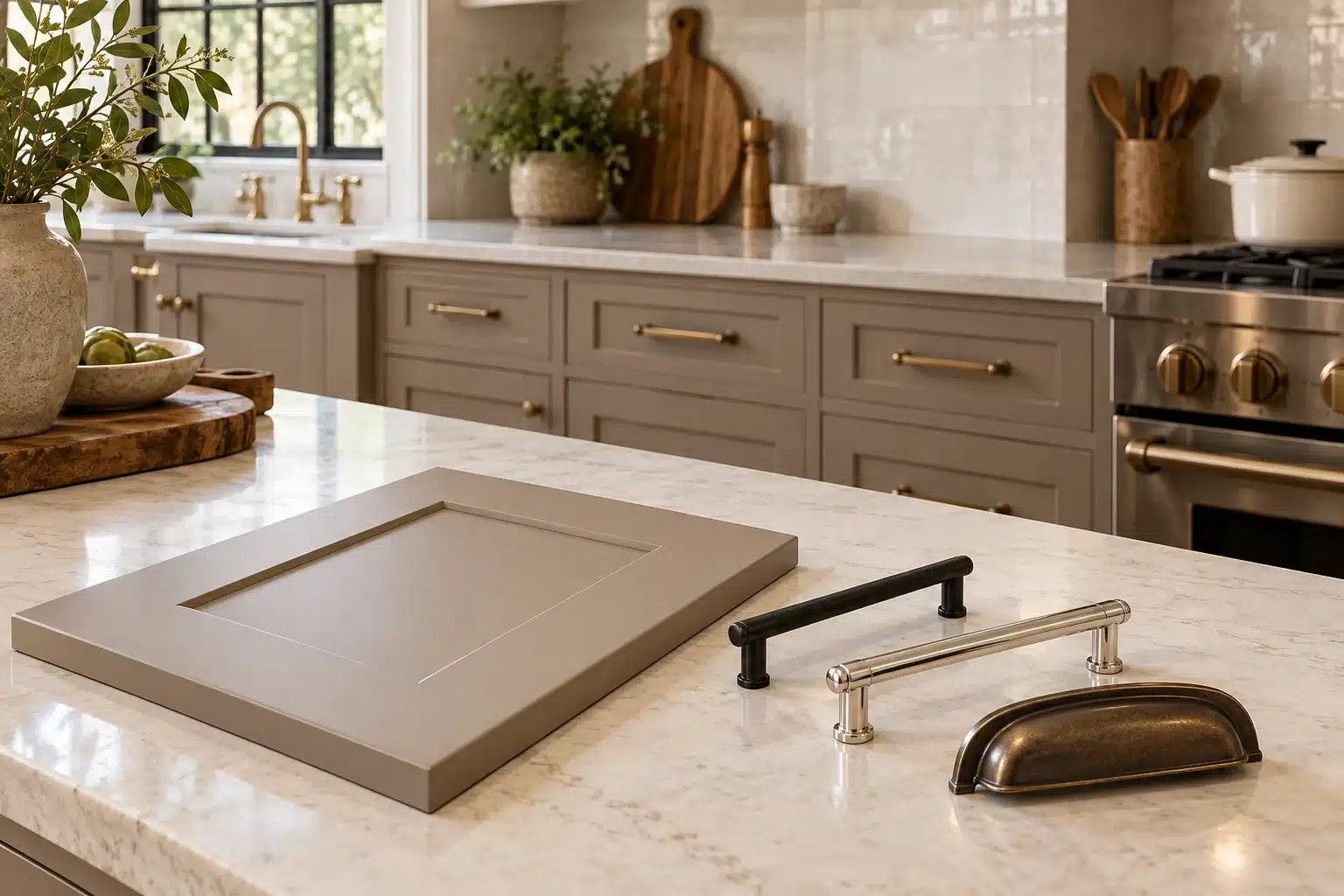
What Hardware Looks Best With Mushroom Kitchen Cabinets?
Aged brass, matte black, polished nickel, and dark bronze can all suit mushroom kitchen cabinets. Choose among them by comparing the actual cabinet color with the countertop, backsplash, and metal finishes you are keeping. Our mushroom paint guide covers the color family; this guide helps you turn it into a hardware decision you can order and install confidently.
Start with two finish samples, then check shape, grip, and existing screw holes before buying the full set. The best-looking finish is not a useful choice if the pull does not fit the cabinet or feels awkward every time you open a drawer.
Which Hardware Finish Works With Your Mushroom Cabinets?
“Mushroom” is not one standardized paint color. Some versions look more beige, some more gray, and others show a pink, violet, or green cast beside neighboring materials. Look at a painted door or a properly prepared sample of your actual cabinet coating rather than relying on the paint name.
The table gives you design directions to test. It does not mean that every brass suits every warm cabinet or that cool-looking counters require nickel.
| Finish | Effect to Explore | Pairings Worth Sampling | What to Watch |
|---|---|---|---|
| Aged or brushed brass | A warm metallic accent | Cream stone, oak, warm mushroom, muted green | A strongly yellow sample may dominate a subtle cabinet color |
| Matte black | A clear, graphic outline | Simple doors, pale counters, repeated black details | Large heavy pulls can become the kitchen’s main visual feature |
| Polished nickel | A brighter, reflective accent | Traditional door profiles, pale stone, existing nickel fixtures | Reflections and differences from nearby chrome or stainless steel |
| Dark bronze | A softer-looking dark detail | Wood, warm stone, deeper mushroom | Some samples look almost black; others read distinctly brown |
Judge the Cabinet Beside the Countertop First
Set the cabinet sample upright against the countertop and put the backsplash sample behind it. If the kitchen is already installed, use a real door near the counter. Hold the hardware in its intended orientation instead of laying everything flat on a table.
Ask what happens to the cabinet color when each finish enters the group. Does the brass bring a warmth you enjoy? Does black give welcome definition, or make the doors look heavy? Does nickel relate to the fixtures you are keeping? The useful answer describes the combination, not whether the metal is currently fashionable.
Check daylight and the lights used while cooking in the evening. Sherwin-Williams’ guidance on lighting and finish explains why a paint color’s appearance changes with those conditions. Do the final hardware comparison after the cabinet color has been sampled in the intended kitchen.
If the Cabinets Look Pink or Violet
Try the metal samples beside the countertop before assuming you need a cooler or warmer finish. A warm brass and a bright nickel can each change how you read that subtle cast. Pick the one that makes the complete group feel deliberate. If neither works, revisit the cabinet paint sample rather than hoping the hardware will hide it.
If the Cabinets Look Green or Brown
Brass and bronze are useful candidates for a softer, earthy arrangement. Black can create a more defined outline. Compare the dark options side by side: a brown bronze that works with wood may be a very different choice from a near-black finish.
If the Cabinets Look Fairly Neutral
Let the door profile, countertop pattern, and existing fixtures do more of the work. With a busy stone surface, try simpler hardware. With plain counters and flat doors, you have more room for a distinctive shape or stronger finish contrast.
Three Kitchen Combinations Worth Testing
These are hypothetical Cardinal Decor design examples, not installations we have physically tested. Use them to assemble samples rather than as guaranteed paint-and-metal formulas.
Warm Mushroom, Cream Countertops, and Aged Brass
Try a simple rounded pull on drawers and a related knob on doors. Keep the brass sample close to any faucet or lighting you intend to retain. If those finishes differ, decide whether the difference looks intentional instead of expecting all products called “aged brass” to match.
This direction can work well when wood and stone already supply texture. If the brass looks too yellow, compare a more muted sample before changing the entire palette. Our warm neutral color guide can help coordinate the adjoining walls.
Gray-Mushroom, Pale Stone, and Polished Nickel
Try a restrained pull shape that relates to the door profile. The reflective metal can provide definition without the solid dark line of black. Compare it beside the actual faucet, not a photograph of a similar fixture.
If the kitchen includes stainless steel appliances, judge them as a separate large material. The cabinet hardware does not have to imitate the appliance finish perfectly. Keep the number of competing decorative finishes manageable and assign each one a clear role.
Deeper Mushroom, Oak Details, and Dark Bronze
Try bronze when you want a dark detail with a warmer appearance than the black sample you have tested. Check the distinction from across the room; some bronze finishes will read almost black at that distance.
A slim pull can keep the arrangement quiet. A broader cup pull or large knob will make the hardware more noticeable even in the same finish. Compare the shape and finish separately so you know which part of the sample you prefer.
Should You Choose Knobs, Pulls, or a Mixture?
Start with how the cabinet is used. Try the sample with your hand, including the fingers and grip you normally use. A shape that looks delicate in a photograph may offer too little clearance. A decorative end may catch on clothing in a narrow aisle.
- Knobs: useful when you want a small visual accent or are replacing existing single-hole hardware. Check the base footprint and grip.
- Bar or arch pulls: useful when you want a longer gripping area. Check clearance behind the handle and how the ends feel.
- Cup pulls: consider the opening direction and whether you like reaching underneath for everyday drawers.
- A mixture: assign a consistent rule, such as knobs on doors and pulls on drawers, then check exceptions such as a wide pantry door.
There is no single proportional rule that suits every drawer. Tape paper silhouettes to the fronts to compare visual scale, then test actual hardware for function. A paper outline cannot tell you whether the grip is comfortable.
For appliance panels, use hardware specified for that application and follow the appliance and panel instructions. Do not assume that a longer ordinary cabinet pull is automatically an appliance pull.
Measure Before Ordering Replacement Pulls
The essential replacement measurement is center-to-center distance: the distance between the centers of the two mounting holes. It is different from the handle’s overall length. Lowe’s hardware measurement guide, published February 5, 2025, explains that distinction and the need to check the mounting screws and cabinet thickness.
For example, a 3-inch hole spacing is 76.2 mm by conversion. A pull specified for 96 mm centers is a different mounting size, even if the two handles look similar in an online image. Use the product’s dimension drawing and stated mounting centers rather than rounding a measurement to the nearest attractive listing.
| Measurement | How It Affects the Choice | What to Record |
|---|---|---|
| Mounting centers | Determines whether a replacement pull fits existing holes | Exact distance and unit from the current holes |
| Overall length and base footprint | Determines visual scale and whether old marks remain exposed | Full length plus the size of each mounting base |
| Projection and grip clearance | Affects hand space and nearby obstructions | Handle depth and space behind the grip |
| Door or drawer-front thickness | Affects the required fastener | Total material thickness at the mounting point |
| Clearance when open | Reveals conflicts at corners, walls, and adjacent doors | Any contact or restricted opening |
Remove one existing piece carefully and inspect the finish underneath. A new small base may reveal an old outline, dent, or paint difference. A backplate may help in some cases, but compare its dimensions and appearance before treating it as the solution.
Measure more than one door and drawer. Previous installations are not always consistent. If new holes are needed, decide on filling and finish repair before placing the order. For a kitchen being repainted, coordinate those decisions with the painter before the final coating is applied.
Order a Small Sample Set and Test It in Place
Choose one candidate in each of two finishes, ideally in the same shape and size. That makes the finish comparison clearer. Once you pick the finish, compare any remaining shapes. Buying four unrelated styles in four metals makes it harder to identify what is actually working.
- Check the return terms. Confirm whether samples or opened hardware can be returned and whether special-order finishes are excluded.
- Hold or fit the sample safely. Use existing compatible holes for a temporary installation where practical. Avoid drilling new holes just to compare a finish.
- View the whole run of cabinets. Step back and imagine the hardware repeated across all doors and drawers, not only the best-lit door.
- Test daily movements. Open adjacent doors and drawers, check corner clearances, and try the grip.
- Approve the exact specification. Record the manufacturer, collection, finish code, size, and required fasteners.
Keep the approved sample until the full order arrives. Compare the delivery before installation, including different handle sizes and knobs from the same collection.
Understand the Finish You Are Buying
A finish name describes appearance, but it does not tell you everything about the material or coating. Ask whether the hardware is plated, coated, lacquered, or sold as an uncoated living finish. Look for the care instructions for that exact product.
Casson’s living-finish guidance, reviewed June 25, 2026, describes unsealed metals that develop patina with use and exposure. Choose that behavior intentionally. If you want every handle to stay visually uniform, confirm that the product you are considering is intended to meet that preference.
Cleaning requirements matter as well. Top Knobs’ product-care instructions call for gentle cleaning and drying and warn against harsh cleaners that damage the protective finish. Follow your selected manufacturer’s instructions rather than treating all brass-colored or black hardware alike.
Count the Order by Size and Use
Make a cabinet-by-cabinet list. Count doors, narrow drawers, wide drawers, pantry fronts, and appliance panels separately. Note any fronts needing two pieces rather than one. Do not calculate the order from the number of cabinets alone.
For an illustrative kitchen with 14 doors using one knob each and 8 drawers using one pull each, the base order is 14 knobs and 8 pulls, or 22 pieces. If two of those drawers need a different size, the pull order becomes 6 of one size and 2 of the other. Any spare pieces are a separate choice, not part of that installed count.
Calculate the budget from each size’s current unit price, then add applicable tax, shipping, fasteners, backplates, finish repairs, and installation. Check availability across the complete size range before approving a collection that only has your preferred knob in stock.
Common Questions About Mushroom Cabinet Hardware
Does the Hardware Have to Match the Faucet?
No. You can keep a functioning faucet and use a different cabinet finish. Compare them together and assign a consistent role to each metal. An intentional difference is easier to manage than several nearly matching finishes chosen separately.
Is Brass Always Better Than Black With Mushroom?
No. Brass is a warm accent; black is a stronger outline. The better choice depends on the actual cabinet color, door shape, counter, and level of contrast you want. Use two comparable samples to decide.
Can You Mix Knobs and Pulls From Different Collections?
Yes, but compare the real pieces. Finish names are not a promise of an exact match between collections or manufacturers. Check the color, sheen, shape, and scale together before buying multiples.
What Should You Choose First in an Open Kitchen?
Resolve the fixed finishes and cabinet paint before the hardware. If the kitchen opens into a living room, coordinate the walls with the existing floors so the hardware finishes a coherent scheme.
Reviewed October 27, 2026. Palette examples, sample comparisons, and the order calculation are Cardinal Decor editorial guidance, not reports of product testing. Sources were checked for this revision; Lowe’s lists February 5, 2025, and Casson lists a June 25, 2026 review. The cited Top Knobs and Sherwin-Williams pages did not display clear publication dates. Recheck dimensions, finish specifications, care, and availability before ordering. See our editorial standards.